
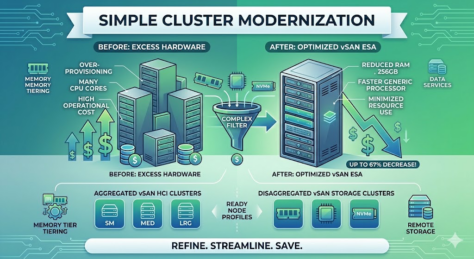
Welcome back, everyone! If you are a true follower of Broad-Cloud.NL, you are probably familiar with my recent posts diving into increased hardware costs and their impact on Total Cost of Ownership (TCO). To combat these rising costs, VMware has been rolling out massive efficiency improvements in VCF 9.x most notably Memory Tiering.
By allowing ESXi hosts to intelligently use NVMe devices as a secondary memory tier alongside traditional DRAM, Memory Tiering drastically increases VM consolidation ratios, freeing you to run more workloads with significantly less expensive RAM.
But Memory Tiering is just one part of the CAPEX-reduction story. Today, I want to focus on another major update that shrinks your datacenter footprint even further with the introduction of completely revamped, much lower vSAN hardware requirements based on new ReadyNode profiles.
There is simply no reason left to hold back from utilizing all the capabilities VMware Cloud Foundation (VCF) offers. By combining the power of VCF 9.x memory tiering with these reduced vSAN hardware costs, you can start with a significantly smaller hardware footprint and still get far more out of your datacenter.
While this will be a relatively short post focused squarely on the new hardware requirements, keep in mind that this is just one piece of the puzzle. The new vSAN ESA architecture brings a host of other massive efficiencies that we aren’t even covering today, including enhanced compression, global deduplication, native S3-compatible object storage, vSAN cyber recovery clusters, and mixed-architecture remote datastore mounting.
Let’s dive into the new hardware requirements and what they mean for your wallet.
The Verdict: Doing Much More with Much Less
The new hardware guidance for vSAN is lower than ever and significantly easier to navigate. You simply choose your deployment type (aggregated vSAN HCI, vSAN storage clusters, or a cyber recovery cluster) and select one of three performance profile sizes.
These all-new, reduced requirements apply to new and existing ReadyNode configurations running vSAN ESA 8.0 and newer, as well as existing servers retrofitted for vSAN ESA.
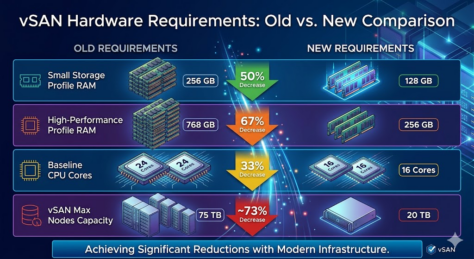
Here is a quick look at exactly how much the requirements have dropped:
The New ReadyNode Profiles
This massive reduction in requirements allowed the product team to simplify the ReadyNode selection process. vSAN offers two primary deployment options, and each now features just three straightforward profiles tailored to specific performance targets.
ReadyNodes for Aggregated vSAN HCI Clusters:
- vSAN-HCI-SM
- vSAN-HCI-MED
- vSAN-HCI-LRG
ReadyNodes for Disaggregated vSAN Storage Clusters:
- vSAN-SC-SM
- vSAN-SC-MED
- vSAN-SC-LRG
How Did This Happen? Telemetry Over Synthetic Testing
Historically, hardware guidance for vSAN was derived from synthetic testing. That method blasts the system with maximum transactions to find top-line performance limits under extreme stress. While useful for establishing absolute boundaries, synthetic tests rarely reflect the actual behavior of real-world production workloads.
To fix this, VMware’s Product Management team took a data-driven approach, analyzing telemetry data from thousands of vSAN clusters running actual production workloads. The findings were clear:
- Real vSAN clusters use much less RAM than synthetic tests suggested.
- Real vSAN clusters use fewer CPU resources than expected.
The True Impact: Cascading Cost Savings
A 67% reduction in RAM or a 33% drop in CPU cores translates to serious five-figure savings on street pricing per host. However, the discrete cost savings are just the beginning. The real magic is in the cascading effects:
- The CAPEX Multiplier: Because vSAN storage clusters consist of several hosts, every dollar saved on a single host’s CPU and RAM is multiplied across your entire cluster.
- Fewer Hosts Required: The most affordable server is the one you never have to buy. Meeting your capacity needs with higher density and lower baseline requirements means you might need fewer physical hosts, which also cuts down on costly network port usage.
- Reduced VCF Licensing: Fewer hardware resources and fewer hosts directly translate to fewer licenses required to run your environment.
- Lower Datacenter Footprint: Reducing the physical server count and component load yields massive operational savings in power, cooling, and rack space—music to the ears of any facility management team.
Final Thoughts
vSAN storage is now the clear option for almost every environment. Whether you are targeting extreme value, top-tier performance, or a hybrid of both, the new resource-efficient vSAN ESA architecture is the answer. Run the numbers for your own environment—you will be amazed by the savings!
End of this post.
Disclaimer: Please note that the views expressed in this blog are solely my own and should be treated as personal opinions. This content does not hold any legal or authoritative standing.