Hi vAdmins and vArchitects,
If you’ve been talking to Enterprise Cloud Architects lately, you know that the real challenge with Generative AI isn’t finding a model but it’s building the platform around it!
Most organizations start with a DIY approach: spinning up raw GPU virtual machines, manually stitching together custom orchestration scripts, hosting standalone vector databases, and managing model weights ad-hoc. While that works for a quick Proof Of Concept, it quickly breaks down when you need Enterprise Multi-Tenancy, Zero-Trust isolation, and proper governance.
That is why I am super excited about VMware Private AI Services 2.1 in VMware Cloud Foundation 9.1!
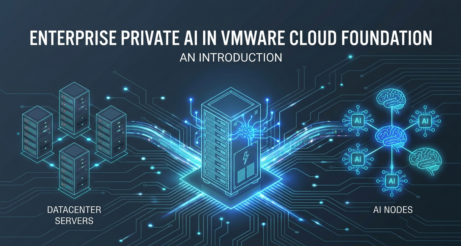
Instead of treating AI as isolated GPU virtual machines, VCF 9.1 abstracts GPU scheduling and LLM tooling into a structured, self-service AI Platform-as-a-Service (PaaS) layer directly inside your vSphere Namespaces.
Here is a quick overview of what this release brings to your private cloud:
- Agent Orchestration & MCP Integration: Natively supports the open Model Context Protocol (MCP), allowing agents to dynamically query internal tools and knowledge bases without custom pipeline code.
- Standardized RAG Substrate: Uses PostgreSQL with
pgvector(managed via VMware Data Services Manager or external DBs) to keep vector embeddings securely inside your corporate boundary. - Air-Gapped Operations: Features the Artifact Mirroring Tool (AMT) to stage container images and model weights into local Harbor registries for fully disconnected deployments.
- Multi-Tenant Compute Isolation: Enforces clean GPU memory partitioning per vSphere Namespace using NVIDIA vGPU profiles or direct passthrough—with CPU fallback via
llama.cpp.
What’s Next?
VMware Private AI Services 2.1 moves us away from custom infrastructure plumbing toward a standardized Enterprise AI platform where developers get fast, self-service access and IT retains full governance.
This post sets the stage! In my upcoming follow-up post, we’ll roll up our sleeves and dive into a complete architectural breakdown and step-by-step configuration walkthrough.
Stay tuned, and as always, happy Private Cloud Building!
End of this post.
Disclaimer: Please note that the views expressed in this blog are solely my own and should be treated as personal opinions. This content does not hold any legal or authoritative standing.